


Table of Contents
An effective church social media strategy will cater to the audience’s interest in engaging with the ministry outside of the church. It will also ensure that it achieves the objectives outlined by the church communication strategy.
Way back in 2013, a Barna study found that 54% of Christian millennials watch online videos about faith or spirituality.
Fast forward to 2017, and the behavior augments. More than half of the Bible readers used the internet (55%) or a smartphone (53%) to access biblical texts.
Here is a snapshot of how millennials, in particular, use the internet for their faith.

Both these trends indicate that churchgoers are interested in engaging with their ministry and faith outside of the church.
Even though church texting services can help you here, another way to cater to that behavior is by engaging with them on social media.
Given that 70% of nonprofit communicators cite social media as one of their most important communication channels — and that the Pew Research Center puts social media use among U.S. adults at roughly seven in ten, with YouTube and Facebook still the most widely used platforms — a documented social media marketing strategy for churches is no longer a nice-to-have.
“Christ has no online presence but yours,
No blog, no Facebook page but yours,
Yours are the tweets through which love touches this world,
Yours are the posts through which the Gospel is shared,
Yours are the updates through which hope is revealed.
Christ has no online presence but yours,
No blog, no Facebook page but yours.”
The question is, rather, how to craft a church social media strategy to use it right. This post can help you there.
What is the best social media strategy for churches?
The best church social media strategy will depend upon:
- The church communication strategy that is already in place
- Gaps in existing social media outreach
- The KPIs you have defined to measure your goals
Since these aspects are unique for every church, the “best social media strategy” is not universal.
However, you can use this article to build the best social media strategy for your church. Before you go ahead reading this post, here are 3 things to consider:
- Keep in mind your church’s communication strategy: Every communication strategy for a church is built around a primary objective. It could be to increase engagement within the congregation, to bring more new members in, or simply to get more visibility.
Remember that the church social media strategy we are discussing today is part of achieving that goal. So, see how you can tweak it to achieve that.
- Define the biggest problem your church has with social media today: It is quite likely that you already have a social media presence. Before you read on, take a look at the gaps in your current church communication – Is it infrequent postings, or do you need more engagement? Or do you need more followers?
- Identify measurable outcomes: Set up a way to measure the outcome of your efforts. What does it look like? Not in terms of likes, but in terms of church growth (how many members did it bring), and visibility (are you being perceived as a small yet thriving community?)
These three points will form the backbone of your church social media strategy. Once you have that straightened out, go ahead and use this post to see how you can build on it.
If you are in a hurry, take a quick look at the Dos and Don’ts for an effective church social media strategy
| Church social media strategy steps | DOs | DON’TS |
| Planning | Keep your goals realistic and achievable | Do not set goals without looking at past data or the resources available to you |
| Craft a separate strategy for your social media goals | The more you post, the more engagement you are likely to get. Remember to respond to every comment/ tag – this is the best way to engage online. | Do not forget storytelling and engagement. Simply posting about church timings and sermon updates will not work. |
| Pick the channel(s) you want to focus on | Encourage your audience and followers to share their stories on social channels. Nothing beats user-generated content | Do not jump into all the channels at once. It is quite resource-intensive to post regularly on all channels. So start with one (or two) and then work your way up. |
| Set up a social media posting calendar | Vary the kind of content you publish, the timings, etc. to see what has more engagement | Do not post without taking into account the target audience. The same kind of content will not work across all channels. |
| Experiment, analyze, repeat | Ensure that measurement metrics are already in place | Don’t forget to use data to guide your next efforts |
What is a church social media strategy?
A church social media strategy is part of the church’s communication plan to help achieve church goals by engaging existing and new followers on social media.
Keep in mind that a church social media strategy is not merely social media outreach (even if the two terms are often used interchangeably).
A church social media outreach has two goals:
- To reach a new audience
- To engage the existing audience better
The social media strategy gives a step-by-step breakdown of how to achieve these goals, based on the resources at your disposal.
| An effective church social media strategy involves 5 steps 1. Plan (set goals, past performance, take stock of resources, define budget) 2. Craft a different (separate) strategy for each of those goals 3. Pick the channel you want to focus on 4. Set up a social media posting calendar 5. Experiment, analyze, repeat |
Here is an in-depth look at each of these steps to help you map out a powerful church social media strategy for your church.
1. Planning
Before you plunge into crafting a strategy, be aware of the resources at your disposal, namely
- The amount of time.
- Manpower.
- Money.
This will give you a realistic idea of what you can achieve with your social media outreach and help you set achievable (yet ambitious) goals.
For instance, let us suppose that you want your social media outreach to bring in new followers to the church. However, if you have just one volunteer at your disposal, then the number of posts you can push out will be limited.
So you can set a goal of bringing in 5 new members to church every month via social media outreach. Or, even improving your church visitor follow-up strategy for those who come in via social media.
DON’T: Do not set goals without looking at past data or the resources available to you.
DO: Keep your goals realistic and achievable.
2. Craft a different strategy for each of these goals
Your church outreach strategy can be used to:
- Build awareness about your church – To reach a new audience.
- Improve engagement – Your congregation engages outside of the ministry.
- Increase conversion – A non-christian/ or non-member to sign up for your church event, attend a sermon, or simply sign up for a newsletter.
- Promote loyalty – Encourage your church members to spread the word in the online community about your church.
Each of these above goals needs a separate plan by itself. For example, engaging your congregation involves sharing updates about events that have happened, and tagging visitors who attended.
However, creating interest in an event entails posting with a specific hashtag, getting the local community involved, and promoting it with ads.
Take into consideration that the number of resources at your disposal will play a pivotal role in each of these goals. For example, if the resources are limited, then you would want to focus on a primary goal (e.g., improving engagement), and gradually increase attention towards the others.
DONT: Do not just post updates about church timings and sermon updates. Make storytelling and engagement a part of every post.
DO: Do remember to respond to every comment and tag.
You May Also Like: How to Write a Great Phone Script for Ministry Fundraising (Sample Scripts Included)
3. Pick the channel you want to focus on
The social media channel you pick will depend upon the audience demographic and how you can engage them.
Take a look at how the audience demographics (by age) of various social media platforms:
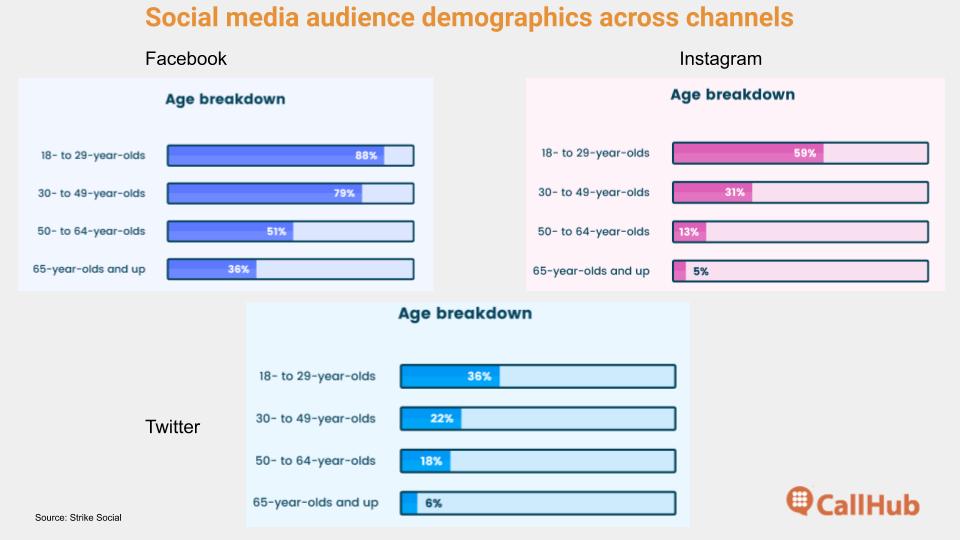
The platform you pick will depend upon the channel that makes the most sense to your audience. For engaging millennials and baby boomers, you could opt for Facebook and even emails.
However, if you also want to reach the younger members in your congregation, namely the Gen Zs, then using Instagram (or even Snapchat) is a great idea.
Read Also: How to pick the perfect church communication software and use it right
84% of Churches have Facebook pages. If you are among them, a good start. If you fall in the latter 16% now would be a great time to consider having one:
- Facebook pages show up on Google search: If a new member is searching for your church, Facebook posts and images can pop up on the SERP.
- Facebook still offers the widest reach of any social platform: Meta’s own quarterly reporting now counts roughly 3.5 billion daily active people across its family of apps, so it remains the broadest net a church can cast
- Facebook stories directly reach your audience feed: Even though you could struggle with organic reach via posts, adding a story on your FB account ensures that it reaches all your followers
What content can you post?
- Share announcements (the latest happenings at your church).
- Hold FB live stream of sermons.
- Post pictures and videos of life at your church, with links to your website.
- Share your opt–in shortcodes on the website for new/existing people to join your texting list
Here is an example of how Waters Edge Church uses its FB profile to keep its audience updated with the church’s events:

They included the details of the service, directed the audience to which channels the content will be available, and also shared a link for registration – full points for making it easy for your audience to engage.
You can also form a separate FB group for your congregation. Just ensure that entry is restricted (and is always admin authorized).
X (formerly Twitter)
Around 16% of churches keep an account on X, the platform that was Twitter until its 2023 rebrand. It is still a low-effort way to promote your church on social media day to day, because:
- The platform reports in the region of 250 million daily active users, so short, frequent posts still find an audience.
- Posting costs nothing but a few minutes, which makes it realistic for a one-volunteer communications team — and paid promotion of a single event is cheap to test alongside it.
What content can you post?
- Share quotes, thoughts, scriptures, and blurbs.
- Trending news-related content with the right hashtags.
- Reposting what your members put out themselves, so engagement runs both ways.
Keep in mind that standard posts on X are still capped at 280 characters – so keep them succinct. The CrossPoint Church’s feed is an excellent example:

Notice that even such a simple post has gained some engagement in terms of retweets and likes!
Only 13% of churches have an Instagram account. That is a heavily missed opportunity because:
- Instagram has passed 3 billion monthly active users — a milestone Meta announced in 2025 — and all of them are reachable with images, Reels, and video.
- Pew Research Center finds Instagram use is highest among adults under 30 — well above the national average — making it the clearest route to the younger half of your congregation.
- It rewards two-way contact, which is where most best practices for church social media engagement start: replying to comments and DMs, and re-sharing what members post about your church, rather than only broadcasting.
What content can you post?
- Share high-quality video of sermons and events as Reels or in-feed video — IGTV was retired in 2022, and its long-form videos were folded into Instagram’s standard video formats.
- Use it for live feeds of your sermons.
Reach your audience with stories about how your church has changed the lives of its members. Here is an excellent example of how Northland Church uses its stories section on Instagram:

In the above example, the stories are divided according to the locations (e.g. Jamaica), where the missionaries carry out their good work.
You can also use hashtags of the city you are posting it from – as the Instagram algorithm will show those posts to people in that area.
DON’T – Do not jump into all the channels at once. It is quite resource-intensive to post regularly on all channels. So start with one (or two) and then work your way up.
DO – Encourage your audience and followers to share their stories on social channels. Comment, like, and re-share their posts as much as possible. User-generated content is the best validation.
Other channels — Pinterest, Snapchat, and more recently TikTok and YouTube Shorts, where short vertical video now drives most of the organic reach — are worth exploring if that is where your audience already spends its time. Usefully, most social media tips for churches transfer to a newer platform unchanged: go where your people already are, publish on a rhythm you can sustain, and answer everyone who replies.
4. Set up a social media posting calendar
Having a detailed social media posting calendar is important to ensure regular postings across channels. Most ministries find it easiest to work a month at a time: a monthly social media plan for churches is short enough to stay realistic for a volunteer team, yet long enough to cover a full cycle of services, holidays, and events. Whichever cadence you settle on, the calendar should:
- Span across all your chosen channels.
- Take into account all your communication objectives and special events.
- Be flexible and allow room to keep up with current events.
- Have an 80/20 rule – 80% helpful content, 20% promotional.
DON’T – Do not post without taking into account the target audience. The same kind of content will not work across all channels. E.g. while Facebook audiences engage via long posts and groups, audiences on X favor short, frequent ones. In contrast, Instagram audiences prefer visual content. And videos work well on most channels.
DO – Experiment across channels to find the kind of content (and timings) that get you the best results.
5. Experiment, analyze, repeat
Go back to the metrics you have outlined during planning to see if your efforts are working out. The KPIs (Key Performance Indicators) for your church are extremely unique to your church.
For instance, if you are a small church, then having a 250-member service would be a success. On the other hand, for a larger church, the goal would be to have huge services of 1000 members or so.
The idea of a KPI is to ensure that you can track the impact your church social media strategy brings to your congregation.
Here are some concrete metrics you can measure:
- How many people attended the service after seeing an ad on X (formerly Twitter)?
- How much money did your recent online fundraising ideas raise?
- Is social media fundraising a better alternative to regular fundraising efforts?
- How many visitors to your website were from social media (and how many of them converted)?
You can, of course, look at more numbers if it makes sense to your church. The objective is to go back and revisit your strategy if it is not bringing you optimal results.
Don’t: Don’t forget to use data to guide your next efforts
DO: Ensure that measurement metrics are already in place
Takeaway
For your social media strategy to work well, consistency is key. Having a regular social media calendar can help you there. You can also make social a key part of everyday service. Share a short post or photo from your service each day, and invite your congregation to join in.
Remember that social media is an excellent channel to foster communication within smaller groups. So encourage your members to come together and share their faith online.
Feature image credits: David Dibert